
Last updated September 20, 2026
Full 25-point door and opener safety check with every visit - springs, cables, rollers, tracks, and your LiftMaster or Chamberlain opener included
You get a price before we start. It does not change when the truck arrives.

 Before
 After
After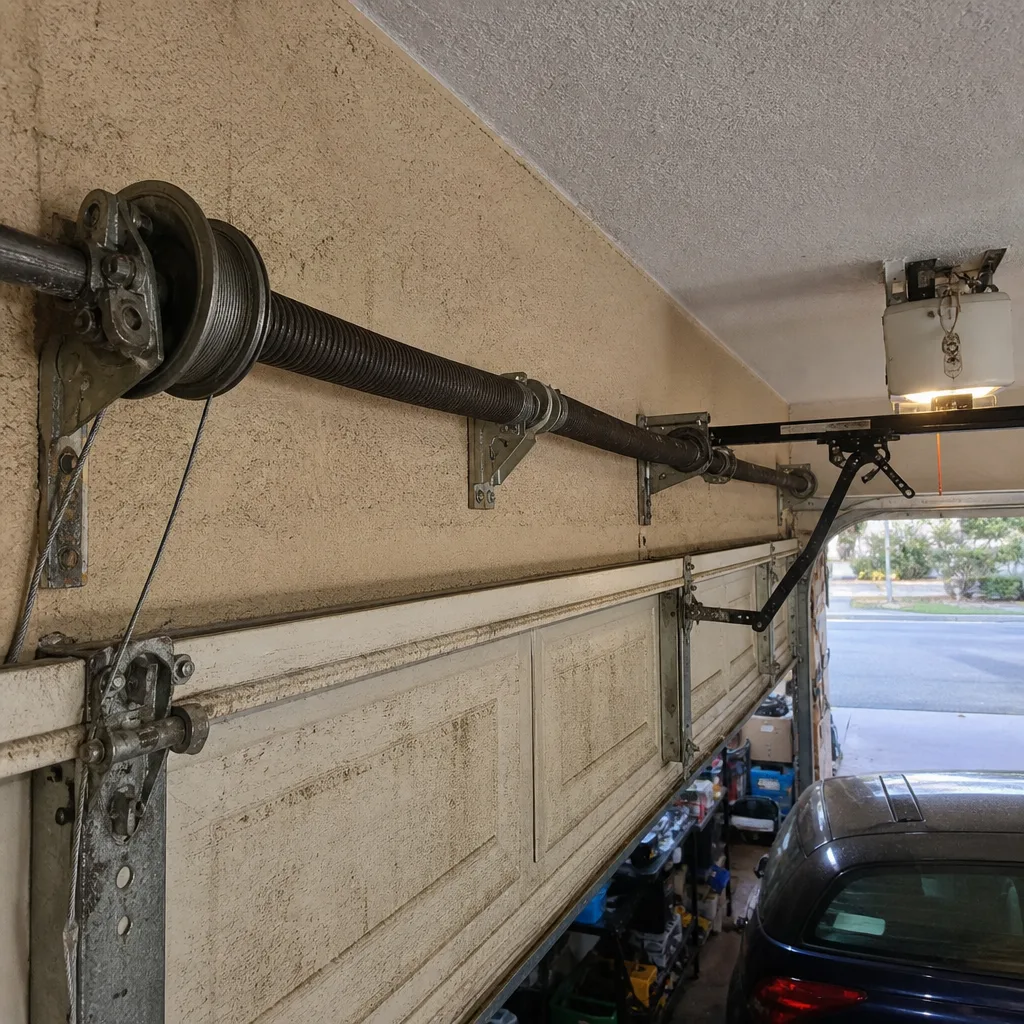 Before
 After
After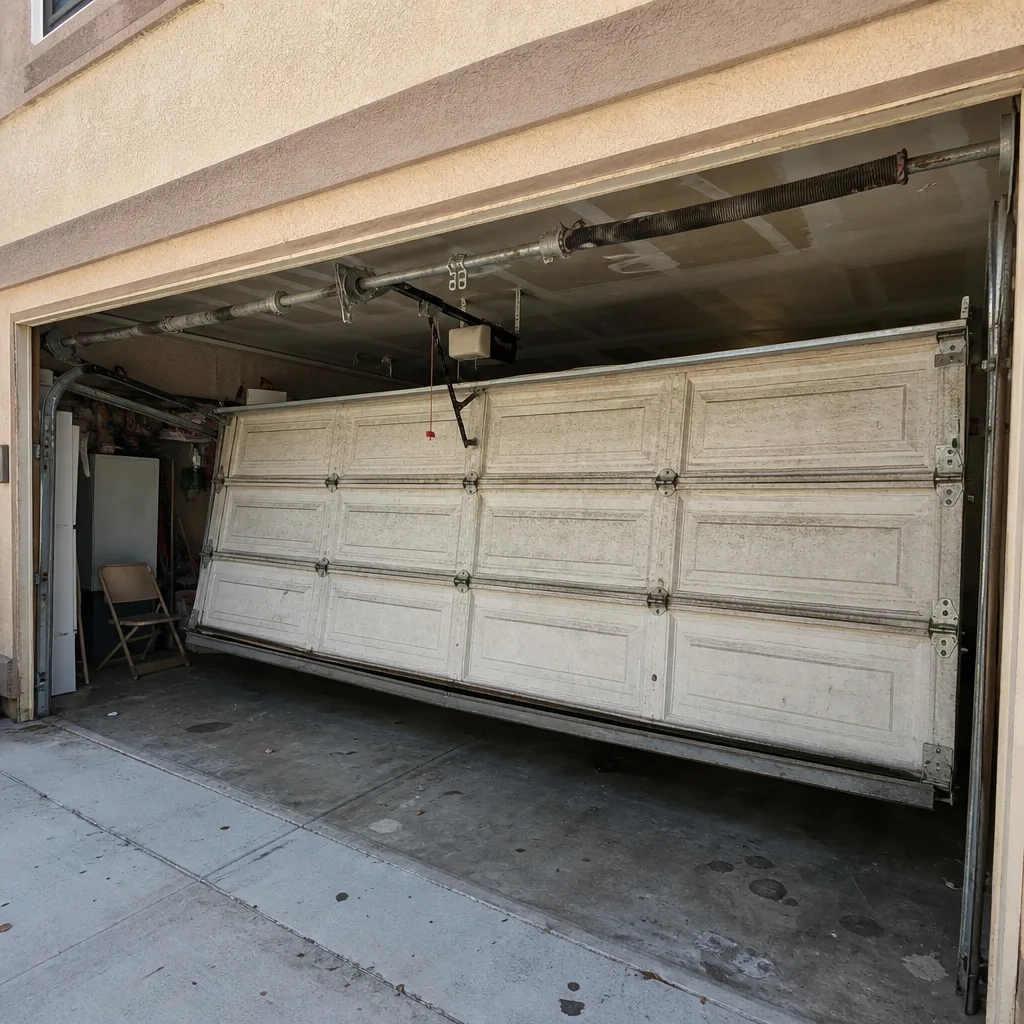 Before
 After
AfterGarage Door Repair Maintenance Checklist for Corona Homeowners
Spraying WD-40 on a garage door spring is one of the most common homeowner mistakes we see in Corona, and it does real damage. That thin, solvent-heavy spray strips the factory coating from the coil and accelerates the exact corrosion it was meant to prevent. The right lubricant is a lithium-based grease, and it goes on the coils, not the cable drum. This guide names the specific part, the correct product, the application interval, and the symptom that means you’re already past maintenance and into Garage Door Repair services territory. You’ll learn the balance test, the photo documentation habit, and the threshold list that separates a tune-up from a service call.
Quick Answer
A garage door maintenance checklist for Corona homeowners should include a lithium-grease lubrication of the torsion spring coils and rollers every six months, a balance test performed twice a year, a visual inspection of cables and hardware monthly, and a photo record of all components before and after each cycle. In Corona’s heat and dust, the standard annual tune-up undershoots what the hardware actually needs; most doors here benefit from a twice-yearly lubrication cycle and a full inspection before and after the summer heat season. For Garage Door Warning Signs: A Corona Homeowner’s Reference Guide, see our dedicated resource.
Table of Contents
- The Part-Specific Lubrication Protocol
- The Balance Test: A Safe Procedure Anyone Can Perform
- Photo Documentation: Why Your Camera Is a Maintenance Tool
- The Threshold List: 8 Observations That Move an Item From Monitor to Schedule
- Corona-Specific Intervals: Why Annual Advice Undershoots Here
- Common Mistakes to Avoid
- When to Call a Professional
- Frequently Asked Questions
BeforeAfterThe Part-Specific Lubrication Protocol
Most maintenance checklists tell you to lubricate moving parts. That’s not wrong, but it’s incomplete to the point of being useless. A garage door has at least five distinct lubrication points, and they do not all take the same product. Get this wrong and you’re not just wasting time. You’re shortening the life of the components.
Here’s the protocol we use on every door we service in Corona. This is the same sequence our technicians follow, documented so you can replicate it safely.
The Five Lubrication Points
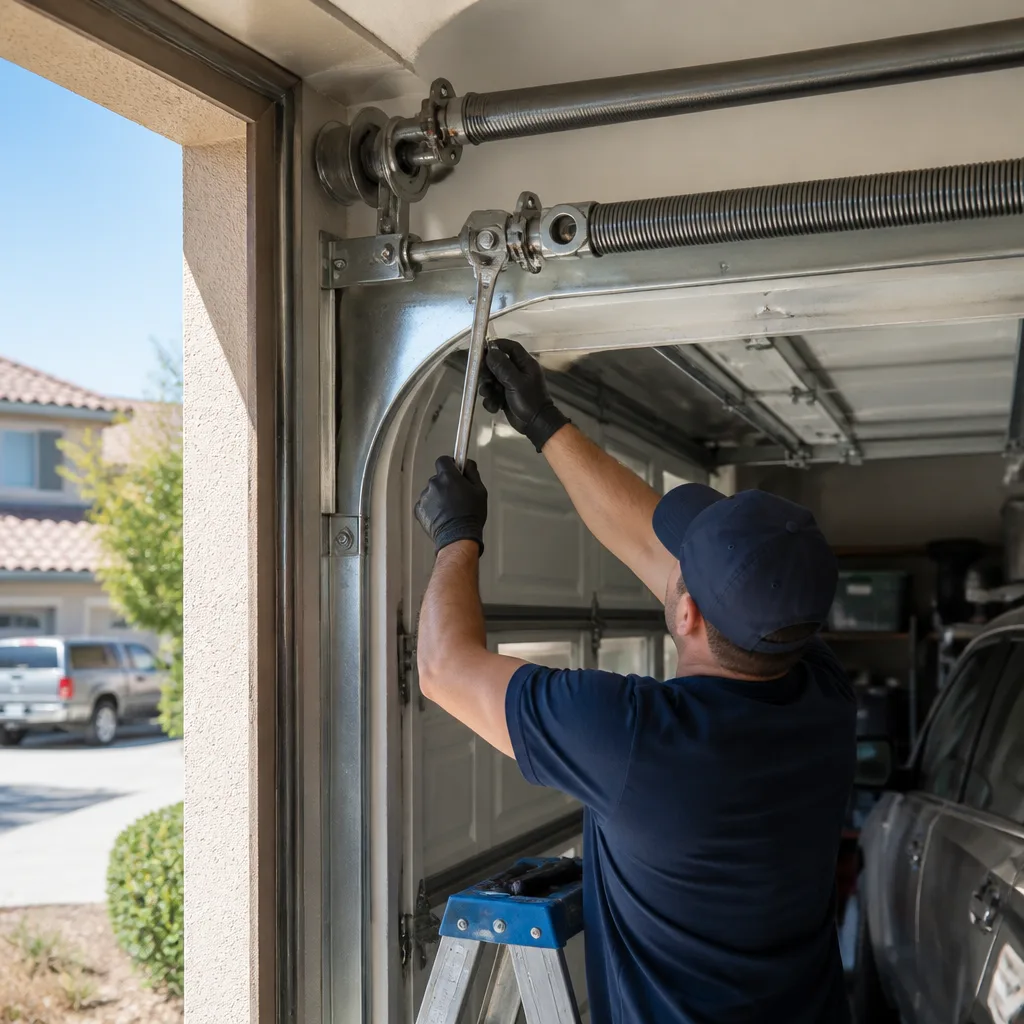
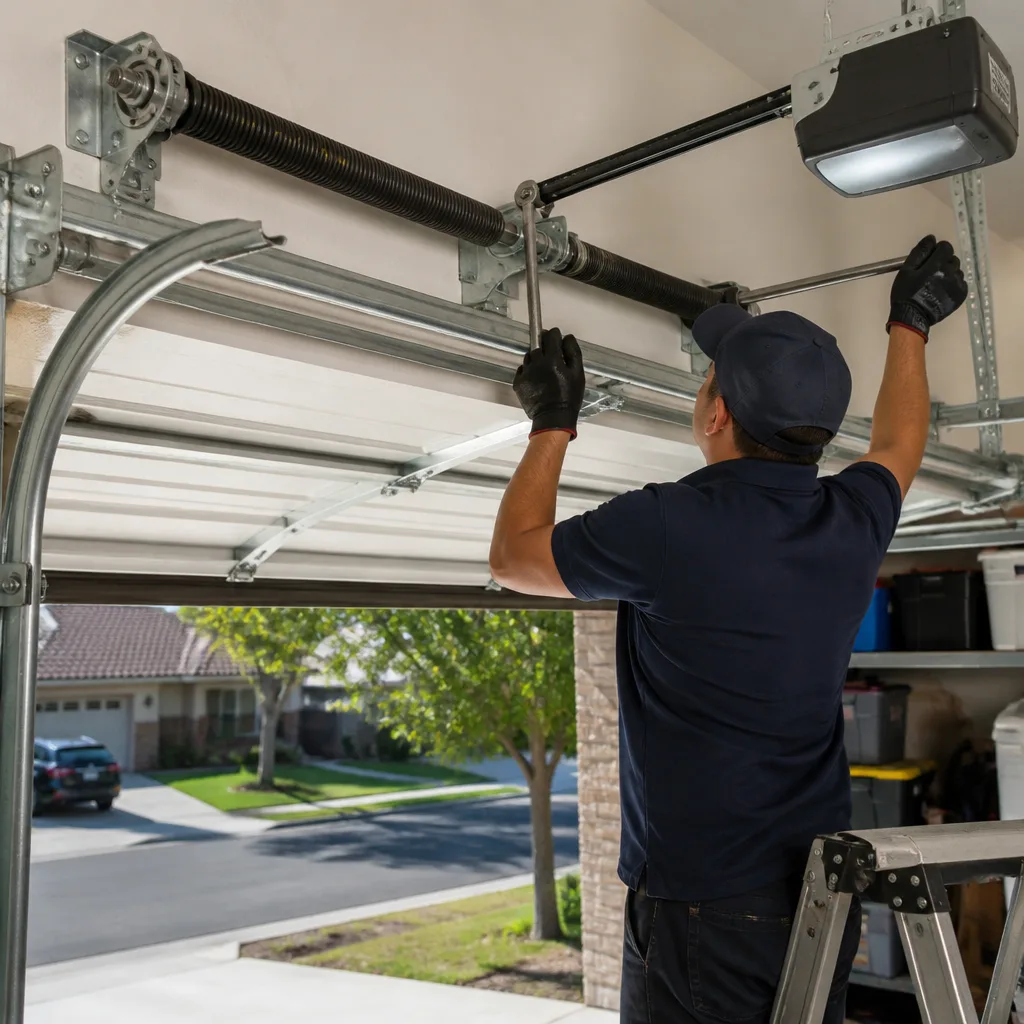
- Torsion spring coils: Use a lithium-based grease or a dedicated garage door spring lubricant. Apply a thin coat along the top of the coil while the door is closed. The grease works into the coil as the spring winds and unwinds. Do not use WD-40, silicone spray, or any penetrating oil. These strip the factory coating and leave bare steel exposed to whatever the Inland Empire air throws at it.
- Rollers: Use the same lithium grease, but only on the ball bearings inside the roller, not on the wheel surface. If the roller has no exposed bearings, it’s a sealed unit. Leave it alone. The wheel itself should never be greased. Grease on the wheel surface collects grit and grinds the track.
- Hinges: A drop of lithium grease on each hinge pin, twice a year. The hinges are the most overworked, under-lubricated parts on the whole assembly. They flex every single time the door cycles.
- Track: Nothing. The track should be dry and clean. Grease here does nothing but collect dust. If the door is binding in the track, the problem is alignment or a worn roller, not a lack of lubrication.
- Cable drum and cables: Nothing. Cables are under tension and should never be lubricated. A lubricated cable slips on the drum. A slipped cable is how doors get jammed crooked and how cables get frayed.
Application Interval
Every six months, minimum. In Corona, we recommend doing this in April and October. April gets the door lubed and inspected before the summer heat season, when the steel expands and the dust is at its worst. October does the same before winter, when the temperature swings between cold mornings and warm afternoons can cause condensation on bare metal.
The Symptom That Means You’re Past Maintenance
If you open the door and hear a grinding or squealing that doesn’t go away after lubrication, the bearing or the coil has already worn past the point where grease helps. Grease reduces friction; it doesn’t restore metal that’s already scored or pitted. That’s a repair call, not a maintenance item. On a torsion spring, any visible rust or a gap between coils means the spring is in active failure. Do not try to adjust or replace a torsion spring yourself. The stored energy in a wound spring is enough to break bone. That’s a trained-technician job, full stop.
The Balance Test: A Safe Procedure Anyone Can Perform
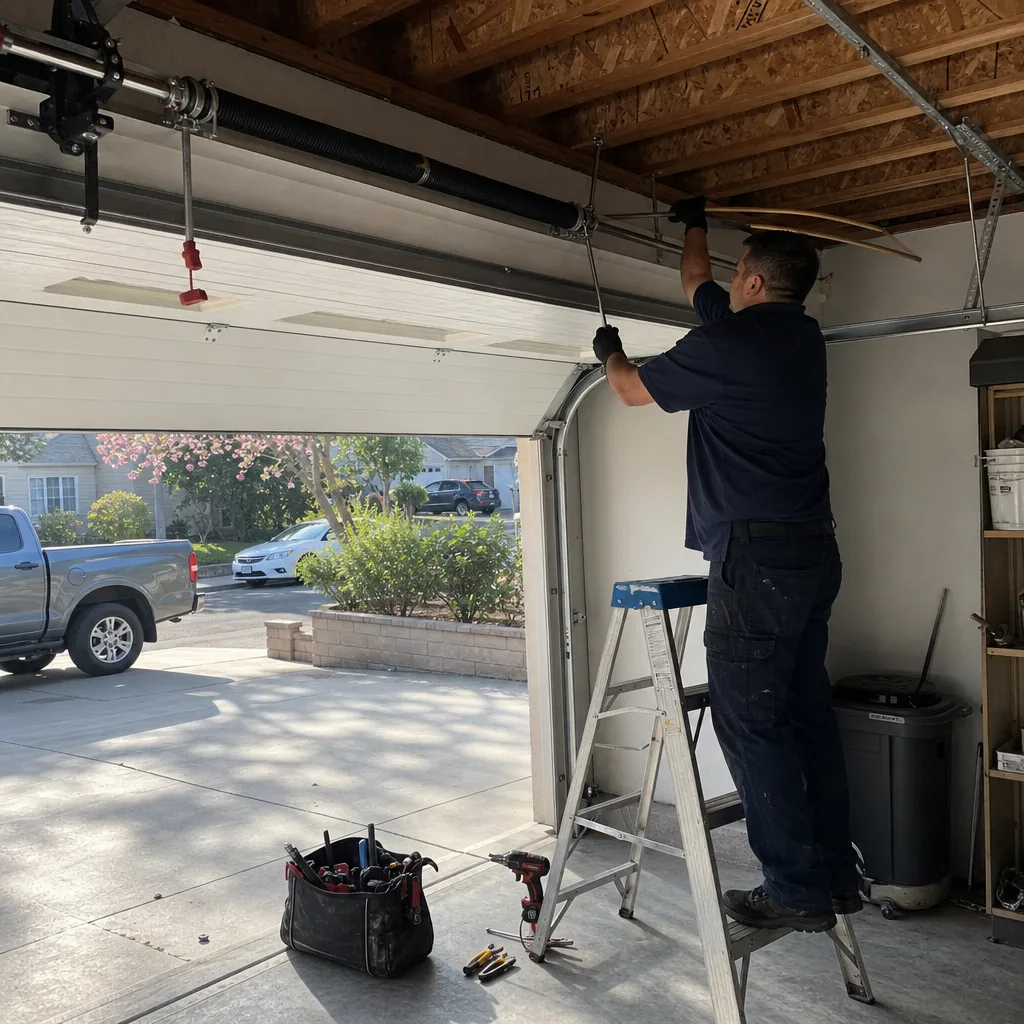
The balance test is the single most reliable diagnostic a homeowner can run without tools. It tells you whether the springs are doing their job, which is compensating for the weight of the door. A door that’s properly balanced will stay put when you lift it to waist height and release it. A door that drifts is telling you something. Here’s the procedure.
The Procedure
- Close the door completely.
- Pull the red emergency release cord. This disconnects the door from the opener carriage, so you’re testing only the door and springs, not the motor.
- Lift the door manually by the bottom handle, not by the top edge. Bring it to waist height, roughly three feet off the ground.
- Release the door. Watch what it does.
Reading the Results
- Door stays put: Springs are balanced and doing their job. Move on.
- Door drifts down more than a few inches: The springs are losing tension. This is early-stage spring fatigue. You have weeks, not months, before the door gets noticeably heavy to lift and the opener starts laboring.
- Door drops quickly: The spring is not holding tension at all. This is a service call this week. A door that drops is a door that can come down on a car, a kid, or a leg.
- Door rises on its own: The springs are over-tensioned. This is less common but just as important. An over-tensioned spring is over-stressed and will break sooner, and the door flies up when released, which is a pinched-finger hazard.
- The full door from inside, closed. Establish the overall condition.
- Each torsion spring, close up. You’re looking for coil gap changes, rust, or coating wear over time.
- Each cable and cable drum. Fraying starts small. Photos let you compare month to month.
- Each hinge and roller. Worn rollers develop flat spots that are visible in photos before they’re audible.
- The opener rail and chain or belt. Sag or slack is easier to spot in a still image than in motion.
- A visible gap between torsion spring coils. A properly wound spring has coils touching or nearly touching. A gap means the spring has lost its set and is actively weakening. This is a safety issue, not a cosmetic one. Schedule a technician this week.
- A cable that’s frayed anywhere, even a single strand. One broken strand means the cable is compromised, and the rest will follow. A snapped cable under tension can lash. This is not a wait-and-see item.
- Any rust on the torsion spring. Surface rust is the first stage of spring failure. Once the factory coating is breached, the steel oxidizes. Oxidized steel is brittle. Brittle steel snaps. You have time, but the clock is running.
- The door drifts more than a few inches in the balance test. Covered above. This is the earliest reliable indicator of spring fatigue.
- You hear grinding even after lubrication. Grease reduces friction; it doesn’t replace metal. Grinding means metal-on-metal contact somewhere. That’s a worn bearing, a scored hinge, or a failing roller. Each of those gets more expensive the longer it runs.
- The door shakes or shudders during operation. A smooth door moves in one plane. A door that shakes has a misalignment, a loose hinge, or a failing roller. Operate the door by hand and watch each hinge as it flexes. The one that moves laterally is the problem.
- The door stops halfway and reverses. This looks like an opener problem, and sometimes it is. But it’s often a door that’s suddenly too heavy for the opener to lift because a spring is failing. The opener’s force limit is doing exactly what it’s designed to do: refusing to overwork itself against a door it can’t lift. Don’t just adjust the opener force. Check the balance first.
- You notice a clicking or popping sound from the spring area. That’s the spring binding and releasing as it winds. A binding spring is a broken spring in the making. The coil is catching on something, usually itself, and each catch stresses the metal further.
- April: Spring lubrication and balance test, before the heat season.
- October: Second lubrication and balance test, before the winter temperature swings.
- Monthly: Visual check of cables, hinges, and springs. Two minutes, phone camera, done.
- After any major wind event: Check the weatherstripping and the bottom seal. Santa Ana winds push dust and debris under the door edge.
- Spraying WD-40 on springs or cables. This strips the protective coating and accelerates corrosion. Lithium grease on the coils, nothing on the cables, ever.
- Lubricating the track. The track should be dry. Grease in the track collects grit and grinds the rollers. A door that binds in the track has an alignment problem, not a lubrication problem.
- Ignoring the balance test because the door still opens. A door can open and close normally for months while a spring is slowly failing. The opener is doing the extra work, which masks the problem and prematurely wears the opener gear. By the time the door stops opening, you’re replacing both spring and opener.
- Adjusting the opener force instead of checking the balance. If the door is suddenly heavy and you turn up the opener force, you’re treating the symptom. The heavier setting masks the underlying spring fatigue and stresses every other component in the chain.
- Interpreting any noise as a lubrication issue. Some noises mean worn metal, not dry metal. If lubrication doesn’t change the noise, stop. The next step is diagnosis, not more grease.
- Skipping the photo record because it seems like extra work. The two minutes it takes to take five photos is the cheapest insurance you’ll ever buy on a mechanical system that will eventually fail. Every single component on a garage door has a service life. Your photos are the record of where that clock stands.
Reconnect Properly
After the test, pull the emergency release cord again while the door is in the closed or fully open position, then run the opener. The carriage should re-engage with the trolley on its own. If it doesn’t, don’t force it. Call a technician. The opener carriage and the emergency release are among the most common things homeowners think they’ve reconnected correctly but haven’t, and the result is a door that opens halfway and stops.
Run the balance test twice a year. If you only run it once, the drift will surprise you. We see it constantly in Corona: a door that was fine in March is sagging by September because the spring fatigue was happening gradually the whole time, and nobody noticed until the opener started groaning.
Photo Documentation: Why Your Camera Is a Maintenance Tool
Take photos of your garage door hardware before and after every maintenance cycle. This is not a nice-to-have. It’s the difference between a quote based on evidence and a quote based on trust. Servo Garage Doors was built on the founding rule that the customer sees the failed part before anyone quotes a replacement. That rule is now codified as Clause 4 of The Haven Standard, and it applies to your own maintenance record just as much as to our service visits.
What to Photograph
Why This Matters
When you have a six-month-old photo of a spring with clean coils and a current photo of the same spring with a visible gap, you know exactly when the fatigue happened. You can hand that to any technician and say, here’s what it looked like, here’s what it looks like now. That’s a verifiable maintenance history. It protects you from being sold a replacement you don’t need, and it gives the technician a baseline to work from.
This is the same principle behind the Documented Photo Record we include on every visit. You get evidence of what was found and what was done. Your own maintenance photos are the homeowner version of that paper trail. Take them every time. Store them in a folder on your phone. They’ll be the most useful thing you own when something eventually fails.
The Threshold List: 8 Observations That Move an Item From Monitor to Schedule
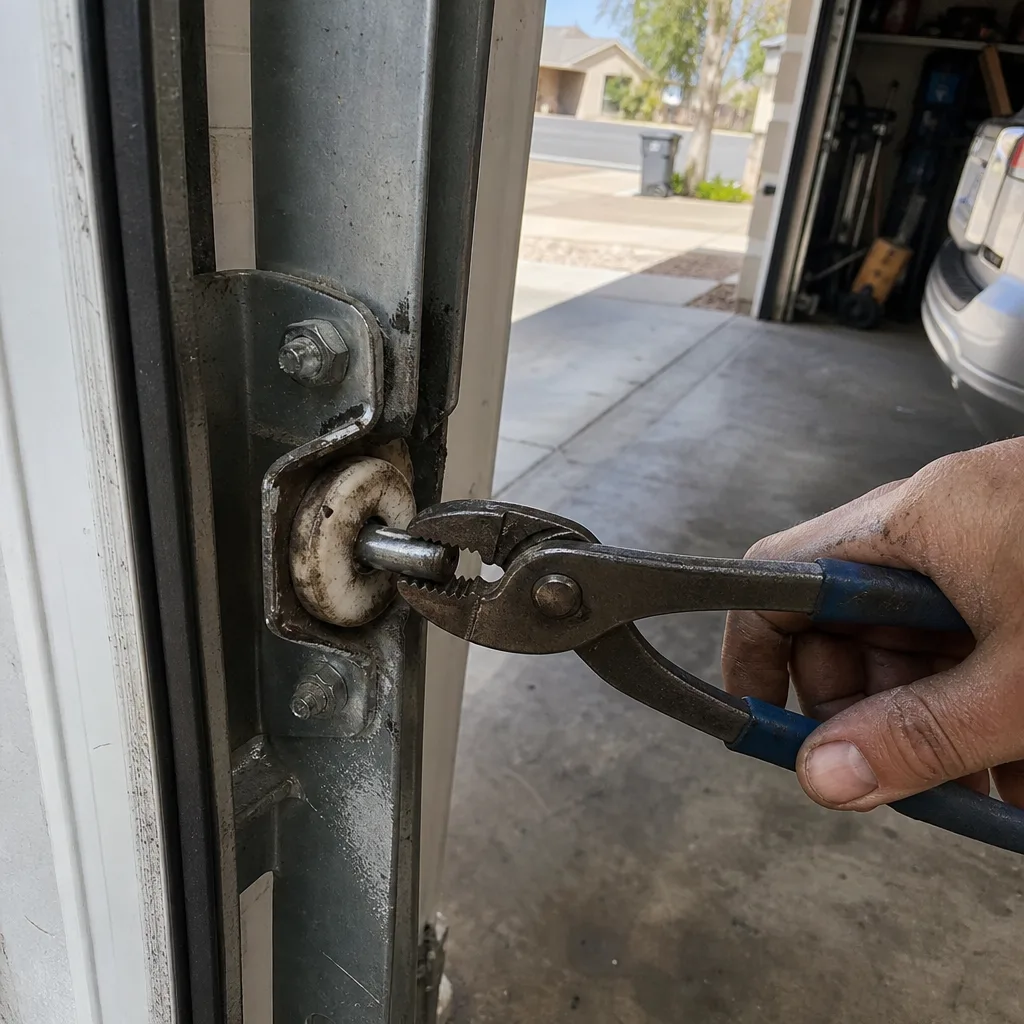
Every maintenance checklist needs a line between things you watch and things you act on. Here are eight specific observations. Each one crosses that line. If you see any of these, you’re out of maintenance and into scheduling.
None of these items gets better on its own. Each one gets more expensive to fix the longer it waits. And on a torsion spring, the failure mode is not a door that stops working. It’s a spring that snaps under maximum tension without warning, and that’s loud enough to sound like a gunshot through the house. The maintenance checklist exists to keep you ahead of that moment.
Corona-Specific Intervals: Why Annual Advice Undershoots Here
Most garage door maintenance advice is written for a generic American suburb. Corona is not generic. The combination of summer heat, fine dust, and temperature swings puts different demands on the hardware than, say, a coastal city with moderate humidity and stable temperatures.
Heat Cycling
Corona summers routinely push past 100°F. A steel torsion spring expands in that heat and contracts when the evening cools down, which is a daily cycle of thermal stress. Over a season, that’s dozens of micro-expansion events. The coating on the spring was not designed for the Inland Empire’s July; it was designed for more temperate conditions. That’s why we recommend lubricating in April before the heat hits. The grease layer is a sacrificial barrier against the expansion and contraction that would otherwise expose bare steel.
Dust Infiltration
The fine, powdery dust that settles on everything in Corona doesn’t just sit on surfaces. It works into the hinge pins, the roller bearings, and the opener rail. Combined with even a small amount of grease, that dust creates an abrasive paste that accelerates wear on the very parts the grease was meant to protect. This is why the lubrication interval here should be six months, not twelve. More frequent, lighter applications do less harm than one heavy annual application that’s been collecting dust for eleven months.
The Real Corona Schedule
If you follow a generic annual schedule in Corona, you’re running your door hardware on a maintenance cycle that’s half as frequent as what the local climate demands. The door doesn’t know what the national average is. It knows it’s hot, dry, and dusty here. Adjust accordingly.
Common Mistakes to Avoid
When to Call a Professional
Any of the eight threshold list items is a reason to call. If the torsion spring has a visible gap, rust, or a break, do not attempt to repair it yourself. The stored energy in a wound spring is enough to cause serious injury. That’s not a warning to take lightly; it’s the reason spring replacement is consistently the one garage door repair professionals and homeowners alike agree should never be DIY. Cable repairs carry the same constraint: those cables hold tension, and a snapped cable lashes. For opener logic boards, limit switches, or any component you can’t visually identify, the fastest path to resolution is a trained technician who can name the failed part and show you the evidence. Read our How to Hire a Garage Door Contractor in Corona: A Step-by-Step Guide to know what to look for. Servo Garage Doors Corona offers written, flat-price estimates before any work starts, in Corona, with a documented photo record on every visit. Call (951) 482-7637.
Frequently Asked Questions
Every six months. In Corona, the April and October schedule accounts for the summer heat cycle and the winter temperature swings that generic annual advice doesn’t address. Use lithium-based grease on the torsion spring coils and roller bearings only. If you need help with a garage door repair in Corona, a technician can handle the lubrication as part of a full inspection. Call (951) 482-7637 for an exact quote.
A door that drifts more than a few inches has fatiguing springs. That’s not a maintenance item; it’s a repair indicator. Continue using the door, but schedule a spring inspection this week. The longer it runs under-tensioned, the more stress goes to the opener and hinges. For a written price before any work starts, Servo Garage Doors Corona provides flat, upfront pricing on every job.
No. WD-40 is a penetrating solvent, not a lubricant for torsion springs. It strips the factory coating from the coil and leaves bare steel exposed. Use a lithium-based grease instead. If you’re unsure which product to use, ask a technician on a maintenance visit. We’re happy to show you exactly what goes where.
Run the balance test and the threshold list. If the door drifts, the springs are worn, and if the coils show rust or a gap, the spring is approaching end of life. In many cases, replacing the springs and worn rollers is all that’s needed. A full door replacement is only necessary when panels are damaged, the track is bent, or the door itself has structural issues. For a documented assessment with photos, the garage door installation team in Corona can evaluate what’s actually necessary. Call (951) 482-7637 for a free estimate.
That’s thermal contraction. When the door sits overnight and the temperature drops, the metal components cool and contract, which changes the tolerances slightly. The noise is friction in a hinge or roller that’s already tight. It quiets down as the moving parts warm up. If the noise persists all day, it’s a different story. That’s a wear indicator. The opener repair and installation team in Corona can diagnose whether the opener or a mechanical component is the source. Call (951) 482-7637.
A maintenance visit should include a full balance test, spring inspection, cable and drum inspection, roller and hinge inspection, opener force and limit check, lubrication of all appropriate points, and a documented photo record of everything found. At Servo Garage Doors, every maintenance visit also closes with a written summary of what was checked, what was lubricated, and what, if anything, is approaching the repair threshold. That’s the standard we work to under The Haven Standard, Clause 1: written price before work, documented record after. Call (951) 482-7637 to schedule.
The Bottom Line
Maintenance is not a series of vague tasks. It’s a schedule, a set of specific products, and a record you keep. Lubricate the torsion spring coils and roller bearings with lithium grease every six months, in April and October. Run the balance test at the same interval. Photograph the hardware each cycle. Check the threshold list monthly. In Corona, the climate demands more than the national average: the heat, the dust, and the temperature swings mean a twice-yearly cycle, not an annual one. The door tells you when it’s struggling. The checklist is how you hear it before the spring snaps. Explore more guides & resources to stay ahead of common problems. To get a professional baseline check, call Servo Garage Doors Corona at (951) 482-7637 for a free estimate.
Written by Marcus Deller, Owner at Servo Garage Doors Corona, serving Corona since 2015.